- Week 2
- Educational Technology paper:
A Computer for All Students-revisited www.nctm.org/index.htm/mt/mt-pages/issues/vol89-1996/vol89-no9-dec1996/vol89-no9-soundoff.htm
This article, from the Mathematics Teacher, talks about how technology can realistically be brought into the mathematics classroom. The original article(1992), said that the graphing calculator was a great tool because of the cost, but did not do as many things as the computer, so it wasn't as useful. Recently, a new calculator, TI-92, has been developed that graphs, does algebra, geometry, trigonometry, and calculus as well as most computer software programs. The greatest advantage is that each student in the class can have one to use during class for the price of four or five computers. The authors then go on to discuss how the development of this new "hand held computer" makes reaching the goals of the state and NCTM possible.
I completely agree with all that the authors have mentioned in this article. It is extremely hard to develop lessons for students in mathematics when you have only a cell of four computers to use for the whole class. This TI-92 would be much better even if the students only had them in class. I have seen what this calculator can do and it is amazing. Basically, anything that computer software programs can do so can this calculator. This calculator is going to make some of the standards reachable and will bring the mathematics classroom into the computer age. Most math teachers do not use computer software because it is to hard or time consuming. This calculator and its availability to every student, right in the classroom, eliminates those problems. In conclusion, I think that this type of technology is the wave of the future for the mathematics classroom. - Curriculum resource:
NASA
This website is a helpful curriculum resource for both mathematics and science teachers. The site is broken down into various categories. The most important of which is subject area. Beyond this, the individual subjects have their own sub-categories. For example, the mathematics area has lesson plans, current projects at NASA, related computer software, videos, and also various other internet listings that have related mathematics resources. - News article:
California Requires Teachers to be Computer-Literate www.nytimes.com/search/daily/bin/fastweb?getdoc+site+site+7314+0+ 0AAA+%28california%29%26and%26%28teachers%29%26and%26%28computer%29
This article, from the New York Times, discusses the decision by the State of California government to require all public school teachers to be computer literate. The new teachers, in order to be certified, and the veteran teachers, to stay certified, will have to meet certain technology standards. The standards for being computer literate have not been developed at this time. This law was passed by the legislature in order to show that knowledge of technology is important to everyone, not just young people. They believe if teachers expect students to be knowledgeable in technology, then the teachers should be able to guide the students into using computer technology.
I agree with this law and feel that it is a first step in making computers a part of every school in the state. This law is an example of the state forcing some teachers to practice what they preach. Many teachers feel that computers and other technology are great tools but either decide not to or do not know how to use them. I think that if New York State passed a similar law then both new and veteran teachers would have the ability to meet the standards set forth by the state and such organizations as the National Council of Teachers of Mathematics (NCTM). Many veteran teachers say they cannot meet the standards because they do not know how to use computers and refuse to go learn on their own. This law would force any teacher with this belief to be a part of the computer age. This law will also open up a wide range of resources that many teachers do not even know exist. In closing, I feel that this law can help teachers relate better to students and find resources for their courses. Therefore, I believe that this will be a very positive piece of legislation for the children and the whole state of California.
THoover@ir-high.moric.org
- Educational Technology paper:
- Week 3
- Educational Technology paper:
Graphing in the Information Age: Using Data from the World Wide Web by Juli K. Dixon and Christy J. Falba Article
The journal article I chose is from one of the National Council of Teachers of Mathematics (NCTM) journals called Mathematics Teachers in the Middle School. The article focuses on using the World Wide Web in the mathematics classroom to teach various types of graphing. The authors discuss how having internet access in the classroom is advantageous when it comes to collecting data for graphing or for research on various math related topics. They also say how in the process of collecting data from the web the students have to summarize statistics, analyze data, make conjectures, and communicate information effectively. These aspects of the data collection parallel the standards set forth by the National Council of Teachers of Mathematics (NCTM). In the article, five activities follow that have the students collecting data from the internet and creating graphs to represent the data. They sum up the article by stating that these activities will help to make the students critical consumers.
I agree with the main theme of this article that it is good for students to learn to summarize statistics, analyze data, make conjectures, and communicate information effectively. I also feel that this article would make a wonderful curriculum resource for any mathematics teacher. These activities bring mathematics into the real world for many of our students. The activities in this article involve things that many of the students will be doing for the rest of their lives and some do already. Many times teachers use the internet just to use it and do not really have a good plan of doing so. The authors of this article have obviously put many hours into developing these activities so they follow the curriculum, use technology, and parallel the standards set forth by the NCTM and the state of New York. Therefore, I feel that this article is an excellent example of a method of using technology in education.
Travis Hoover
THoover@IR-High.moric.org - Curriculum resource:
Geometer's Sketchpad Activities
SketchpadThe website I found is a page that has activities for use with the Geometer's Sketchpad software. The website has access to various activities for a wide range of students. Each activity has a connection from the page and an explanation of what mathematics topics the students will learn about in the activity. This is very helpful to the first time user and both teacher and student in the classroom. The activities teach a variety of different geometry topics.
I feel that this is an excellent site for use as a curriculum resource for a mathematics teacher. The teacher with internet access in his/her classroom can have the students do the activities on the internet while the teacher without internet access can model the activities on paper and have the students work through the worksheets with the software. This page is alligned with the high school mathematics curriculum. Most of the material on this page is included in the New York State Regents Curriculum. In fact, a teacher at Indian River was looking for activities to do with the Geometer's Sketchpad software but couldn't find any resources. I just told her about this page and she is looking into trying this in her Course II classes. She should be able to use this page effectively in the scope of the course. Overall, I feel that this is a very good curriculum resource for mathematics teachers. The page is small but the activities stimulate many different ideas for activities in the classroom using Geometer's Sketchpad.
Travis Hoover
THoover@IR-High.moric.org - News article:
At UCLA, Mixed Reaction to Web-based Course
PaperThis article I found was in CyberTimes on the internet and discusses the professors attitudes at UCLA and various other colleges about having Web-based courses. At UCLA, it is now required that every course have some form of a web page. Each course is required to have at least a syllabus on its page. The article gives quotes from various professors at UCLA and other colleges giving some of the pros and cons of having a web page for each course. Some of the teachers who dislike the idea are afraid that the technology will control what is taught instead of what is being taught controlling the technology. Others feel that the internet makes the professors job easier because he/she never has to lug all the projectors, tape players, and other academic materials around campus. This doesn't need to be done because everything can be placed on the web. Another professor said that the college only required the pages because they were increasing the technology fee at the college and this would make this change easier to take if it looked like the school was doing things for the students with the money. The final professor in the article, states that giving a television based generation more television to watch is not a college education in his mind. Other questions about who owns the course if it is on the internet were also mentioned.
I feel that it can be beneficial in some cases for students to be able to take courses over the internet. For example, if this course was offered over the internet I would most likely be achieving at the same rate. But, many courses, mostly math, that I took in college I feel would lose their meaning if they were taught over the internet because the student teacher interaction and discussion would be different. Mathematics is often hard to explain in words and students would lose much of the visual presentations that teachers make. I realize that these things can probably be done on a computer but I do not think that it would be worth it. A mathematics teacher needs discussions, diagrams, examples, and arguments often times to decide on an answer and it just could not be done as well on the computer. Overall I feel that many and probably all courses can be taught on the web but there are always some that could be done better in the classroom. This type of course would be great for someone in a distance learning situation but if possible I would recommend going to the class.
Travis Hoover
THoover@IR-HIGH.moric.org
- Educational Technology paper:
- Week 4
- Educational Technology paper:
The center I chose is called AskERIC and is considered an ERIC Clearinghouse. This clearinghouse began as an ERIC Clearinghouse on Information and Technology at Syracuse University. It is now focused on being a resource for all educators. AskERIC has three major parts: Question and Answer Service, Virtual Library, and Research and Development. The clearinghouse provides educators of all types with abstracts from journal articles, lesson plans, projects, educational television series, and professional resources. I selected this clearinghouse because it looked like it would be a curriculum resource for all educators.
I feel that this is a terrific resource for educators in all disciplines. When I first looked at the web site I didn't think that it was going to be very useful for me. I searched for some mathematics related topics but only found abstracts that wouldn't be very useful to me because they were so general. Then I chose the Virtual Library. I found lesson plans, projects, and many other useful resources all organized under their discipline and topic. Even though there were not many resources for the courses I am currently teaching, I can see uses for these in the future. This is definitely a page I will bookmark and come back to at a later date to read more of the lessons and projects that relate to my courses.
Travis Hoover
THOOVER@IR-HIGH.moric.org - Curriculum resource:
I feel that Margo Ross did a wonderful job with her web page. I think that she did an excellent job in teaching some content using the technology rather than deciding what content to teach based on the technology. The web page was very easy to use which is perfect for the age group she is teaching. She also used colors well which will keep the students interested. I can see how putting these topics on the computer would make doing them much easier in the classroom. I know that I would be more agreeable to reading a letter from Columbus to the King and Queen on the computer rather than from a book. I can see that the students would also be much more willing to research information using the web page rather than in encyclopedias. The projects and use of technology that she is using in her teaching also follows many of the standards set forth by New York State and many districts in the area. Overall, I feel that this web page is an excellent use of technology and will cause the students to get interested and excited about going to Social Studies class.
Travis Hoover
Thoover@ir-high.moric.org - News article:
The article I read discusses the use of the internet as a teaching tool for both homeschooled students and students in a distance learning situation. In the state of Alaska the local Galena City School District has set up a program that has increased their enrollment from 160 to almost 2000. This has been done mainly by enrolling many of the students into the IDEA(Interior Distant Education of Alaska) project. This project connects the students throughout the state who are unable to physically get to schools.
I feel that this is an excellent program for the children in the state of Alaska. Many of the students who have been unable to attend school because of where they live or due to a choice to be homeschooled have missed out on many of the social aspects of school. I feel that students need to have a relationship with adults other than their parents (teachers) and children other than relatives (students). This program is helping to build these relationships. The school district has trained both teachers and students to use the internet, chat rooms, and e-mail in an effort to reach all of these students. I think this will be a great asset for all the students who do not go to the public school for whatever reasons. The students can talk to other students or professionals who may know more about certain subjects than their home instructor. This gives the students an outside source of information, guidance, and help. This public-private virtual school, I feel, is a terrific "idea" for Alaska and other states as well.
Travis Hoover
THoover@IR-HIGH.moric.org
- Educational Technology paper:
- Week 5
- Educational Technology paper:
The learning theory that I selected is Learning Styles. The main idea of learning styles is that every person perceives and processes information differently. This learning theory also believes that whether or not you learn something has just as much to do with how you learn as it does with how smart you are. To put it in easier terms, those who believe in learning styles feel that each student learns in a different manner and it is the teachers job to teach in various styles in order to reach all students.
The paper I selected has ERIC NO. ED386098 and is titled: An Investigation of the Learning Styles of Students at Selected Postsecondary and Secondary Institutions in South Carolina. Research Bulletin No. 60. The paper discussed various aspects of learning styles involving 2000 college students and 6000 high school students. They compared learning styles between various disciplines, how the styles related to gender and race, and various other comparisons. The study found that students with applied styles of learning did better in school and on standardized tests. It also found that math majors were in the applied category and those in the humanities, social sciences, education, and business usually fell into the conceptual category.
This article is proof that those with mathematics degrees are most intelligent.
Travis Hoover
BS in Mathematics
THoover@ir-high.moric.org - Curriculum resource:
The site I chose is under the NYS Department of Education and is called the Office of Research Education Research Report. It is located at NYS Ed. Specifically, the research paper is titled What Do Student Grades Mean? Differences Across Schools.
The report focusses on how grades are what parents use to determine how well their children are doing and the basic rules of grades have changed. For example, C is no longer the average, B is. About two-thirds of students in mathematics receive A's and B's. In the poverty schools, those with the most free and reduced lunch, also had an average grade of B in Math and English. Those students in poverty schools who are receiving A's when taking standardized tests get approximately the same score as the C and D students from the rich schools. The article then states that the students in the poorer schools need to be more informed about what courses those in other schools are taking. The article then recommends some questions that the students and parents should be asking.
I feel that grades are a measure of how well you are doing in the course not how well you are doing compared to those in your class. Teachers who have never taught in a different district would assume that their tests are too hard if none of the students are passing until they take some form of standardized test and then it is too late. If we had state wide or national standards then this would not be a problem because the teachers would know what their students need to be able to do at the end of the course. <;>Travis Hoover
THoover@ir-high.moric.org - News article:
Technology in the News
Internet Site to Monitor Educational Programming by Jeannine AversaCybertimes Cybertimes
The article I chose discussed the recently imposed federal rule which requires television stations to air more educational programs. Many public interest groups are encouraging parents to use the internet to let both the Federal Communications Commission and the local stations know that it is working. The article then discusses how the Center for Media Education is starting to allow viewers to send complaints, via a form on their web page, to the FCC about the stations that are not following the rules. On this Web site there are also listings of the educational programs and when they air. The PTA is also trying to get involved by having its members write to television regulators and stations concerning the new programming. Rep. Edward Markey, an advocate of the rule, feels that the TV stations are doing much better than they have previously.
I feel that educational programming should be regulated on television. The stations will not air it due to the lack of revenue it creates and it is necessary to have educational shows on all stations. Most children love to watch television and if it is educational it can be one of the most entertaining teachers.
Travis Hoover
THoover@ir-high.moric.org
- Educational Technology paper:
- Week 6
- Plan:
Travis W. Hoover
Mathematics Teacher
Course I Mathematics
Indian River High School
September 3 - June 24
180-40 minute class periodsDemographic of Learners
Most of my students are tracked as average ninth grade mathematics students. At Indian River we have a mix of local students and military students. My classes have a wonderful mix of gender, race, religion, and ethnicity.
Mission Statement My mission as a Course I mathematics teacher is to have the students leave my classroom understanding how to do algebra, knowing what algebra is, and realizing how algebra will be involved in their lives now and forever.
Macro Learning Objectives
The students will be able to show a basic understanding of the curriculum through a written exam.
The students will be able to show the ability to work with others in order to solve problems.
The students will be able to show respect for each other and responsibility for themselves.
Chapter One - Review Topics
Time Frame:
September 3 - September 5
Learning Objectives:
The Students will be able to evaluate problems using the order of operations.
The students will be able to recognize the properties of operations and name them.
Educational Technology Aids/Curriculum Resources:
Calculators
Basic Methodology:
The methods used in this week are basically drill and practice.
Evaluation Criteria:
The students will be evaluated after the three days of class using a written evaluation.
Chapter Three - Algebraic Expressions
Time Frame:
September 9 - September 25
Learning Objectives:
The Students will be able to write verbal expressions as algebraic expressions
The students will be able to substitute values in for a variable.
The students will be able to write a formula from a sentence.
The students will be able to use area, volume, and perimeter formulas to solve real world problems.
The students will be able to communicate verbal sentences algebraically.
Educational Technology Aids/Curriculum Resources:
Calculators
Basic Methodology:
The teacher will be using cooperative learning, peer tutoring, class discussions, and presentations to obtain the objectives.
Evaluation Criteria:
The students will be evaluated using two quizzes and a chapter test. Each day the students are also evaluated on the work they do in class.
Chapter Four - Solving Equations
Time Frame:
September 29 - October 9
Learning Objectives:
The Students will be able to solve simple equations using inverse operations.
The students will be able to solve simple word problems using let statements.
The students will be able to solve two step equations using inverse operations.
The students will be able to solve two step word problems using let statements.
Educational Technology Aids/Curriculum Resources:
Calculators
Basic Methodology:
The teacher will be using peer tutoring, class discussions, and student presentations to obtain the objectives.
Evaluation Criteria:
The students will be evaluated using a written evaluation at the end of the chapter. The teacher will also be evaluating the students on their daily progress.
- Curriculum resource:
- News article:
- Plan:
- Week 7
- Educational Technology paper:
- Curriculum resource:
- News article:
- Educational Technology paper:
- Week 8
- Educational Technology paper:
Educational Technology Paper for the week of October 23
The instuctional design model that I have chosen is called the Dick and Carey design model. I have related this model to my whole curriculum plan. The model is broken into many steps:
Identify instructional goals-The students will be able to pass the Math A exam at the end of the two year sequence.
Identify entry behaviors-The students currently enrolled in the Math A program are those that have scored below a 75% on the current Regents Competency Exam. Mostly the lower half of the ninth grade class.
Write Performance Objectives-The students will be able to pass the examinations throughout each of the chapters.
Develop Criterion reference tests-The tests that will be given will be related to the final Math A exam that the students will take after the two year sequence.
Develop instructional strategy-We will teach the students using a variety of teaching styles. Real world situations will be introduced as much as possible and the students will be doing laboratory (hands on) exercises throughout the course.
Develop and select instructional materials- The teachers of the course will select the textbook most closely associated with the curriculum and will meet weekly to discuss instructional materials used day by day.
Develop and conduct formative evaluation-Evaluations will be done daily by visual inspection and weekly in the form of written quizzes and exams.
Develop and conduct summative evaluation-The final examination will be the Math A exam that has been created by the state and is still in the writing stage.
Revise instruction-After the year has been completed the teachers will meet to discuss what changes need to be made to improve the course and the techniques used to benefit the students.
- Curriculum resource:
Curriculum Resource Paper for the week of October 23.
The website I found is called Cable in the Classroom and is located at http://www.ciconline.com/textonly/txthom.htm This web site as you can imagine talks about the uses of television in education. A link from this site leads you to an abstract of a magazine article which discusses the uses of television and why it is good for middle school students. Another link that I liked that came from this site was a link of "Curriculum Connections". This link has actual teachers look at different programs that are sent to the schools, free of charge, and find where they fit into the curriculum. For example, a television show on Drugs in America could be connected, according to the reviewer, to both Health and Wellness and Geography classes. Cable in the Classroom mentions how the television is a good method of keeping children of the MTV and Nintendo generation paying attention.
- News article:
Technology in the News paper for the week of October 23
The article that I found on technology was in CyberTimes located at http://search.nytimes.com/search/daily/bin/fastweb?getdoc+site+site+8915+1++%28education%29%20AND%20%28technology%29%20AND%20%28%29 and is called "Workshop Unites New York Teachers and Internet Types". The article talked about a workshop that both teachers in New York City and Computer Executives from Silicon Alley attended. The groups joined together and brainstormed ideas on how they could get the students in the city to be more computer literate. The teachers said that the largest problem is funding for recent computers, software, teacher training, and wiring. Some of the teachers went hoping to find innovative ways to purchase or raise money for computers. The article seems to say that the main objectives of the teachers was to either gain support for funding from the government or to get funding directly from the companies. It was even said that Silicon Alley should follow the lead of Silicon Valley and put money into the education of the young people because that will make their jobs easier in the end.
- Educational Technology paper:
- Week 9
- Sounds:
- Pictures:

- Network:
- Sounds:
- Week 10
- Flow chart:
- Gantt chart:
- PERT:
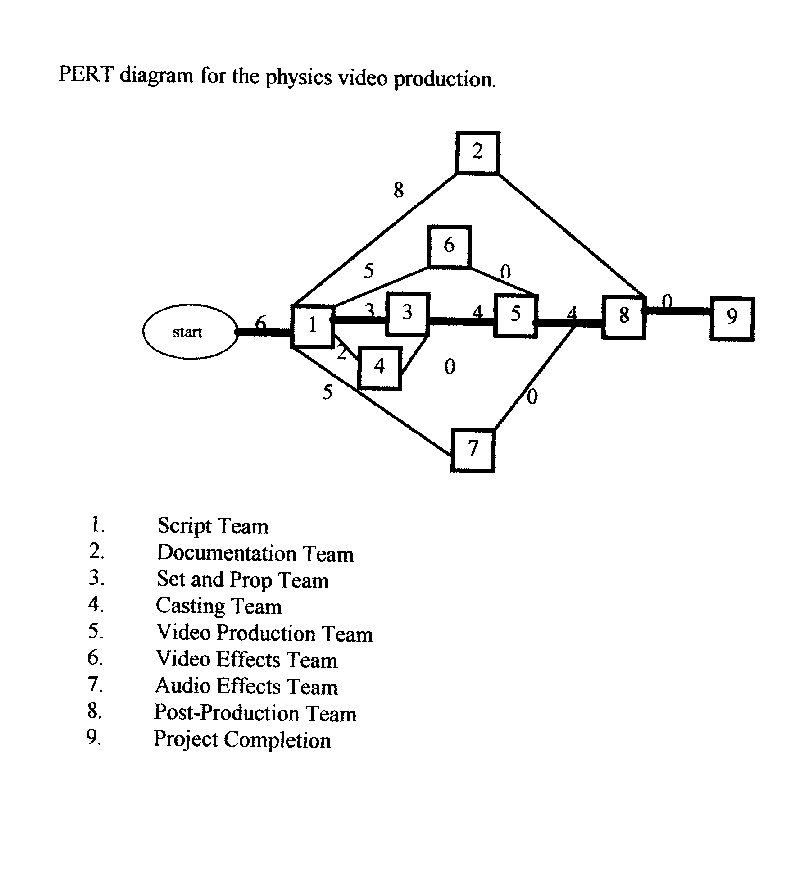
- Gantt chart:
- Flow chart: